This page and the models are generated by a Python script [MTUN3], which requires the package [MTUN1]. The models are displayed with help of a light-weight OFF file viewer written in JavaScript [MTUN2].
Note: for optimal experience Javascript should be enabled.
Introduction
One day I was looking for a good example of a general polyhedron with the symmetry of a tetrahedron. My friend Don Romano suggested that the tetartoid would be a good one. This inspired me to investigate these a bit more.
Select the section you are interested in from the pull-down menu below
A is a general dodecahedron consisting of pentagons. On Wikipedia the following definition is used: It uses the input values 'a', 'b' and 'c' and then one face is defined by the vertices:
- (a, b, c)
- (−a, −b, c)
- (−n/d1, −n/d1, n/d1)
- (−c, −a, b)
- (−n/d2, n/d2, n/d2)
with
- 0 ≤ a ≤ b ≤ c
- n = a²·c − b·c²
- d1 = a² − a·b + b² + a·c − 2·b·c
- d2 = a² + a·b + b² − a·c − 2·b·c
- n·d1·d2 ≠ 0
With this page I want to investigate what happens for certain values of 'a', 'b', and 'c'. I think the first requirement is mainly to keep the tetartoids convex. It is definitely possible to have values that don't fulfil the requirement. During this investigation I am not keeping this requirement strictly. Note that for any triplet (a, b, c) the triplet (xa, xb, xc) leads to a congruent tetartoid if x ≠ 0. On this page I will refer to all these polyhedra as tetartoids, although the ones with non-convex faces are not tetartoids according to the definition above.
In general tetartoids are isogonal and the pentagons have three different edge lengths. This is easy to understand since two pairs of different sides of pentagons meet in one edge while the fifth side meets its own kind in opposite directions. The pentagon of a general tetartoid has five different angles at the vertices.
For the OFF file models of the tetartoids that are shown here holds that the value of 'a' was scaled to 1 unless a = 0. In that case my script would try scaling the value of 'b' in the same way, and then use 'c' instead if also b = 0. In some tables I might show values that are scaled to get nicer looking numbers.
Note that for the vertices № 3 and 5 there is a divide, which automatically means that the denominator shouldn't be equal to 0, in this case 'd1' and 'd2'. Requirement № 5 is related to that. It also requires that 'n ≠ 0' and that can happen e.g. when a = b = c, which is actually an interesting value to investigate, since it leads to 0 / 0.
The original motivation of the investigation was to look for an example of a dodecahedron similar to the and the , but then with tetrahedral symmetry. I suspected early on that I would end up with a regular dodecahedron, but of course I wanted to try.
As a reminder the definition of d1 and d2 are as follows.
- d1 = a² − a·b + b² + a·c − 2·b·c
- d2 = a² + a·b + b² − a·c − 2·b·c
with the requirement that d1 ≠ 0 and d2 ≠ 0
This section investigates what happens when the value of d1 and/or the value of d2 approaches 0. There are different ways for which this can happen and these are divided into the following categories here.
1. a = b = 0
If c = 0 as well then n = 0 and this is investigated in the section 'When n Approaches 0'. This means we can assume that n ≠ 0 here. If this is the case then both d1 = 0 and d2 = 0. The table below shows how the tetartoid looks like for different ways of approaching the singular point.
| a | b | c | ξ < 0 | ξ ≈ 0 | ξ > 0 |
| ξ | 0 | 1 | |||
| 0 | ξ | 1 | |||
| ξ | ξ | 1 | |||
| ξ | -ξ | 1 |
2. b = 0 and c = -a
If this happens, then d1 = 0. The table below shows what happens when this combination of values is approached from different directions. Since there isn't much variation, more combinations weren't attempted.
| a | b | c | ξ < 0 | ξ ≈ 0 | ξ > 0 |
| 1 + ξ | 0 | -1 | |||
| 1 | 0 + ξ | -1 | |||
| 1 | 0 | -1 + ξ |
3. b = 0 and c = a
If this happens, then d2 = 0. This situation is similar to the previous one.
4. b ≠ 0 and c = f1×b
With fa = a / b and f1 = (fa² − fa + 1) / (2 - fa)
If this happens, then d1 = 0
The case below is close to where n approaches 0, case 2. The offset ξ from the singular point is taken from the value 'c' below, Similar effects occur when the error ξ is used for 'a' or 'b'.
| a | b | c | ξ < 0 | ξ ≈ 0 | ξ > 0 |
| 5/4 | 1 | 7/4 + ξ |
5. b ≠ 0 and c = f2×b
With fa = a / b and f2 = (fa² + fa + 1) / (2 + fa)
If this happens, then d2 = 0
| a | b | c | ξ < 0 | ξ ≈ 0 | ξ > 0 |
| 1/2 | 1 | 7/10 + ξ |
As a reminder the definition of n and the requirement was as follows.
- n = a²·c − b·c²
- n·d1·d2 ≠ 0
with
- d1 = a² − a·b + b² + a·c − 2·b·c
- d2 = a² + a·b + b² − a·c − 2·b·c
This section investigates what happens when the value of 'n' approaches 0. There are different ways for which this can happen and these are divided into three categories here.
1. a = b = c
This is a special case where n = 0, d1 = 0 and d2 = 0, leading to a 0 / 0. It leads to some interesting case and it needs to be investigated separately. Without loss of generality one could strive for a = b = c = 1 and approach this from different directions, which will lead to different polyhedra. In the table below the value of ξ is a positive value the approaches 0.
| a | b | c | ξ < 0 | ξ ≈ 0 | ξ > 0 |
| 1 + ξ | 1 | 1 | |||
| 1 | 1 + ξ | 1 | |||
| 1 | 1 | 1 + ξ | |||
| 1 + ξ | 1 - ξ | 1 | |||
| 1 + ξ | 1 | 1 - ξ | |||
| 1 | 1 + ξ | 1 - ξ |
Note that in the table above the faces of the tetrahedron are actually covered by three faces. It is as if this is a dodecahedron that is folded onto itself in such a way that a tetrahedron appears. The form in the column left of it hints on how it is folded onto itself.
Also note that (a, b, c) = (1, 1 + ξ, 1 + ξ) is the same as (a, b, c) = (1 - ω, 1, 1) after scaling, and that for (a, b, c) = (1 + ξ, 1 + ξ, 1 + ξ) still holds that a = b = c still and that n = 0. This means that these do not need to be investigated further.
Using two or three different offsets isn't investigated further, even though it might lead to interesting results. E.g. for (a, b, c) = (1, 1 - 1.5ξ, 1 - ξ) or (a, b, c) = (1 + 2ξ, 1 - ξ, 1) with ξ →∞ you will get an . It might come as a surprise that such tiny differences can make such a big impact, but then imagine the function f(x) = 1 / x and the impact of tiny differences when you approach the singular point.
2. b·c / a² = 1
Without loss of generality and can set a = 1, which will give b·c = 1.
| a | b | c | ξ < 0 | ξ ≈ 0 | ξ > 0 |
| 1 | 5/4 + ξ | 4/5 | |||
| 1 | 4/5 + ξ | 5/4 |
Note that the tetartoids in the column with ξ < 0 are similar to the butterfly-winged tetrahedron and the twisted butterfly-winged tetrahedron in the previous table.
The picture below shows how the shape of one face changes depending on the value of ξ for a (a, b, c) = (1, 5/4 + ξ, 4/5).
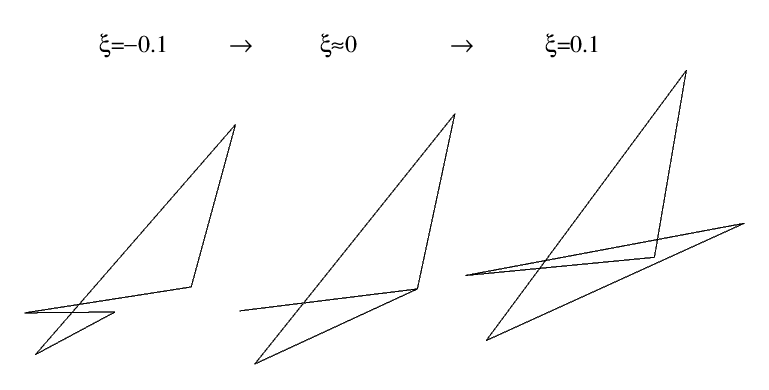
The shared edges forming a line cannot be left out, because they are shared with other types of edges from a different face. Note that two faces connected to those edges end up in the same plane. In the given example of b = 5/4, if you increase the value of b while decreasing the value of c accordingly, then the triangle will become more elongated. For (a, b, c) = (1, 4/5 + ξ, 5/4) the face development looks as follows:
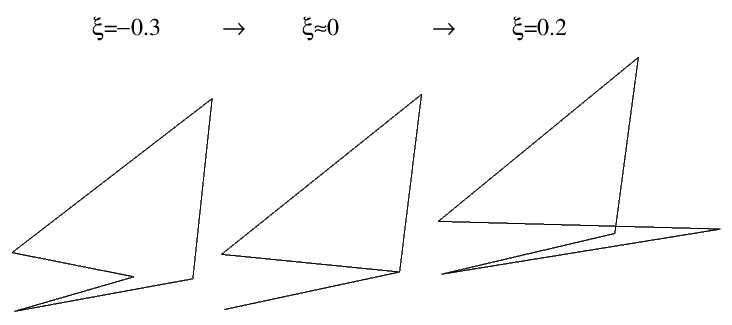
3. a = b = 0
The case was investigated in the section When d1 or d2 approaches 0 already.
4. c = 0
From the definition of n and can see that n = 0 when c = 0. Without loss of generality one can assume either a = 0 or a = 1, In the table below the value of 'b' is chosen to be 2. The values of 'a' and 'b' control the angle between the spikes, where 'a' specifies the distance between the tips along one axis, while 'b' defines the radius of the spikes.
| a | b | c | ξ < 0 | ξ ≈ 0 | ξ > 0 |
| 0 | 2 | 0 + ξ | |||
| 1 | 2 | 0 + ξ |
For certain valid values of a, b and c polyhedra are obtained that are uniform, including results where faces of the tetartoid together form one face of a regular polyhedron. These are shown in the table below, in which τ = (√5 + 1) / 2. It is understood that for all of these it holds that (a, b, c) can be multiplied by a constant.
| a | b | c | Model | Remark |
| 0 | 1 | τ + 1 | ||
| 0 | τ + 1 | 1 | ||
| 1 | 1 | 3 | Each side consists of three isosceles trapezoids. Changing the value of c will still result in a tetrahedron, | |
| 1 | 1.5 | 1.5 | Each side consists of two right trapezoids. Occurs for (a, b, c) = (1, x, x), where x > 1 or x < -1 |
|
| 0 | 1 | 1 | Each side consists of two rectangles Similar to a scaled down version of the previous row, where x →∞ |
The table below shows a series of tetartoids where the faces have bilateral symmetry and the tetartoid becomes a pyritohedron, which means it has a higher symmetry. It will at least have A4×I symmetry. The value of τ in the table is the golden ratio, i.e. τ = (√5 + 1) / 2. For all faces it holds that four sides have the same length.
| a | b | c | Model | Remark |
| 0 | τ + 1 | τ² * 10000 | This is the case where (a, b, c) = (0, ξ, 1) with ξ →∞. | |
| 0 | τ + 1 | (τ + 1)² + 5 | c > (τ + 1)² | |
| 0 | τ + 1 | (τ + 1)² | ||
| 0 | τ + 1 | 2τ + 1 | τ + 1 < c < (τ + 1)² | |
| 0 | τ | τ | ||
| 0 | τ | τ + 1/2 | τ < c < τ + 1 | |
| 0 | τ | 1 | Equilateral faces | |
| 0 | τ | τ - 1/5 | (τ + 1) / 2 < c < τ | |
| 0 | τ + 1 | (τ + 1) / 2 + δ | If δ = 0: Singular point where d1 = 0 | |
| 0 | τ + 1 | 10/9 | 1 < c < (τ + 1) / 2 | |
| 0 | τ + 1 | 1 | ||
| 0 | τ + 1 | 5/6 | 0 < c < 1 | |
| 0 | τ + 1 | δ | If δ = 0: Singular point where c = 0 (and a = 0) |
The table below shows some tetartoids that have equal edge lengths, but that aren't mentioned in the section 'Uniform'. Included are the ones that occur as singularity. For cases where edges get a length of zero it is assumed that this edge must be removed altogether. The value of τ in the table is the golden ratio, i.e. τ = (√5 + 1) / 2.
| a | b | c | Model | Remark |
| 0 | ξ | 1 | With ξ →∞. This is a singularity where d1 = d2 = 0 due to a = b = 0. This polyhedron has a higher symmetry S4×I and with regards to this symmetry it is still isohedral. | |
| 0 | +1 | -τ | This polyhedron has a higher symmetry A4×I and with regards to this symmetry it is still isohedral. | |
| 1 + 2ξ | 1 - ξ | 1 | With ξ →∞. This is a singularity where n = 0 due to a = b = c. This polyhedron has a higher symmetry S4A4 and with regards to this symmetry it is still isohedral. | |
| 0 | τ + 1 | τ | This is a pyritohedron which has a higher symmetry than normal: A4×I and with regards to this symmetry it is still isohedral. |
The table below shows some tetartoids that are special in some other way than mentioned in the other sections. The value of τ in the table is the golden ratio, i.e. τ = (√5 + 1) / 2.
| a
b c |
Model | Remark, where bold text categorises |
| 1
0 τ-1 |
Four edge angles are the same.
The faces in this tetartoid are completely visible. The angles of the isosceles triangles are 36°, 36° and 108°, i.e. they are directly related to the regular pentagon. This isn't surprising when you look at the values of a, b, and c. The pentagons in this tetartoid can be seen completely; i.e. one of the vertices ends up on the long edge and it divides that edge into two parts according to the golden ratio. |
|
| 1
0 τ |
Two pairs of edge angles are the same.
Also in this tetartoid one can recognise the angle from the regular pentagon. Once again, this isn't surprising if you look at the values for a, b, and c. Close examination shows that there is a great dodecahedron at the core and that this tetartoid is in fact a partly stellated great dodecahedron. Two edges of a face are completely hidden. The invisible edges are the missing edges of the pentagrams. The tetartoid in the row above is very similar. It can be obtained from this one by truncation. |
|
| 1
3.274316085206514 1.789861687269396 |
Two edge angles are the same.
There are two different edge lengths with three pentagon edges having the same length. Pairs of vertices end up exactly at the same point. It is the two acute angles that are equal. These are at the vertices that end up at the vertices of the virtual tetrahedron. There are many variants of this one. Using the definition of a tetartoid and solving 'd1 = d2' with 'a = 1' one can calculate that this occurs when c = (1 + b²) / 2b. The one that is shown here is special, since there are only two different edge lengths instead of three. |
|
| 1
0.484454027365491 1.274316689395054 |
Two pairs of edge angles are the same.
There are two different edge lengths with three pentagon edges having the same length. This one consists of faces that look like two mountain tops. Two pairs of angles in these faces are equal up to 14 decimals. Tetartoids always have two pairs of edges with the same edge length, while the fifth edge is separate. For this one the separate edge has the same length as one of the pairs up to 14 decimals. Besides that the two different kinds of vertices that are on the 3-fold axes have the same distance to the centre of the polyhedron. |
|
| 1
0.210137975747359 2.48445804509546 |
Two pairs of edge angles are the same.
There are two different edge lengths with three pentagon edges having the same length. This one consists of faces that look like two mountain tops, with one top higher and other lower and wider. Two pairs of angles in these faces are equal up to 13 decimals. One edge length seem to be the same as another pair, but only up to six decimals. Besides that the two different kinds of vertices that are on the 3-fold axes have the same distance to the centre of the polyhedron. |
|
| 1
0.897128057685865 1.2 |
There are two different edge lengths with four pentagon edges having the same length.
This one consists of faces that look like triangles with a tail. Tetartoids always have two pairs of edges with the same edge length, while the fifth edge is separate. For this one the two pairs have the same edge length up to 14 decimals. Many variants of this exist and if the last edge gets the same length or if angles get equal, then it will turn into a where each face consists of three isosceles trapezoids. |
|
| 1
2.299046757145047 1.2308212694136 |
Two edge angles are the same.
At first one might think that this one has a higher symmetry, but this isn't the case. It can easily be seen when you look at a 3-fold axis at the core of the tetartoid. For this one holds that it is the obtuse angles that are the same and there are many variants of this. There are also variants for which it is the acute angles that are equal instead. I haven't found one for which both are pairwise equal. It seems for this to work one has to make the spikes very long and sharp. This is an example of one for which the acute angles are equal up to 14 decimals, while the obtuse angles differ less than 4°. |
|
| 1
-0.540860231494099 2.595651659868778 |
Two edge angles are the same.
In this caltrop-like polyhedron it is the acute angles that are equal. Many variations of this one with the same property exist. What is a bit special with this variant is that the shorter edge lengths are almost the same as well; the difference is only 0.04 (2.23 vs. 2.27). |
|
| 1
0 -0.444095920388923 |
There are two different edge lengths with three pentagon edges having the same length.
Two edge angles are the same. Three edges have an edge length of 2. The two angles that are the same form a Z shape, which means that two edges are parallel. All edges can be seen completely. |
This sections contains some examples where the user can change a certain value through a slide-bar, while seeing how that affects the tetartoid. Note that the 3D player scales the model to fit the window. This means that any scaling effects caused by the slide bar cannot be observed here.
| Model | Remark |
| The models shown in the section "Pyritohedra"` can be morphed into each other by using constant values for 'a' and 'b', while varying the value for 'c' from a small positive value to a very large value. | |
| In the section "Other Interesting Tetartoids" there are caltrop-like tetartoids with and without self-intersections. The button on the left shows a tetartoid that can used to morph these into each other. The slide bar will vary the value 'c' from 1.01 to 2, while a = 1 and b = 2. Note at c = 1.4 there is a singular point where d2 = 0. You can continue to drag the slide bar to the right until a cube is formed. One could also have used another value for 'b'; for instance if . | |
| In the section "Other Interesting Tetartoids" there is a tetartoid "Tetrahedral drill head" where it is stated that several of these exist for a = 1, b > 1 and c = (1 + b²) / 2b. For all these models it holds that the two angles in a tetartoid face are equal. It is the angles at the vertices that are shared that are equal. | |
| Using the same relation for a, b and c as for the "Tetrahedral Drills", but with where 0 < b < 1, then you will get the mountain-faced tetartoids, for which it still holds that the vertices on the 3-fold axes share the same point in space. | |
| For these it holds that a = 1 and b = c, where b varies from a very small positive number to a big positive number. For b = c = 0 there is a singular point for which n = 0. N also equals to 0 for a = b = c = 1. This is close to the initial position, see also the section "When n Approaches 0". In the situation where b goes towards infinity the tetartoid can be rescaled to get the shape for (a, b, c) = (0, 1, 1). |